The $500 Billion Pivot: Everything About the India-USA Trade Deal

New Delhi: In a world of shifting alliances and economic volatility, the news of February 2, 2026, stands out as a watershed moment. After a year of intense tariff wars and diplomatic brinkmanship, India and the United States have officially signed a landmark trade agreement.
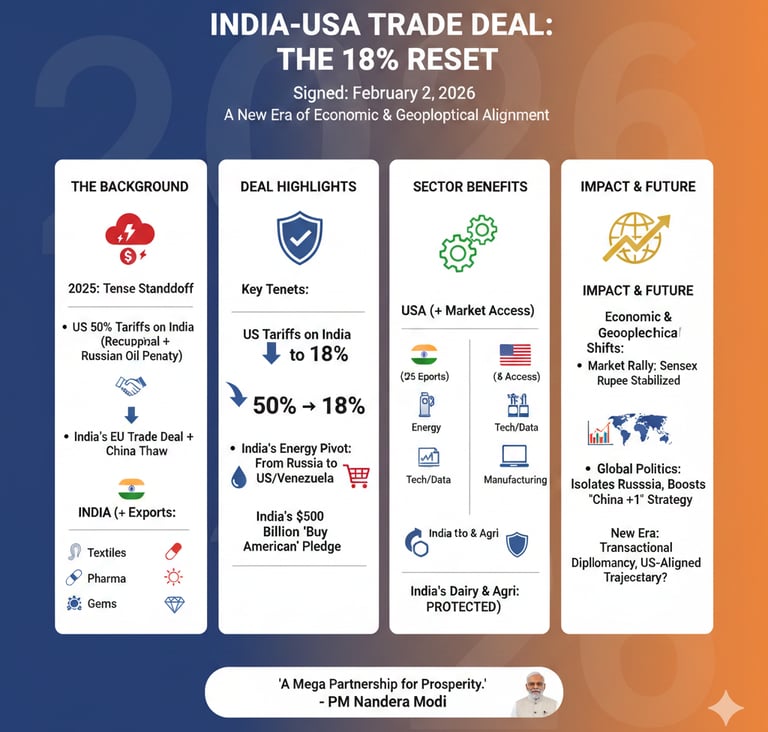
Announced following a high-stakes call between Prime Minister Narendra Modi and President Donald Trump, the deal—often referred to as the "18% Reset"—effectively ends a period of trade hostility that had seen Indian exports taxed at a staggering 50%.
A Year of "Economic Brinkmanship"
To understand the significance of the 2026 deal, we must look back at the friction of 2025. For nearly 10 months, the trade relationship was on life support. Washington had labeled India a "tariff king," specifically targeting its domestic protectionism.
The situation reached a boiling point in August 2025 when the US imposed a combined 50% tariff on a wide range of Indian goods. This was composed of:
25% "Reciprocal Tariff": Part of the US's broader policy to match the import duties of its trading partners.
25% "Punitive Penalty": Specifically targeting India’s continued and massive procurement of Russian crude oil following the Ukraine conflict.
India responded by diversifying its trade routes, finalizing a massive FTA with the European Union in late January 2026 and signaling a "thaw" in relations with China—moves that many analysts believe finally forced Washington back to the negotiating table.
The Breakthrough: What’s in the Deal?
The agreement is built on a "quid pro quo" that addresses both economic and geopolitical needs.
The 18% Tariff Cap
The headline of the deal is the reduction of the US import duty on Indian goods to a flat 18%. This is a dramatic drop from the 50% peak and, more importantly, places India in a superior competitive position compared to its regional neighbors. Currently:
India: 18%
Vietnam: 20%
Bangladesh: 20%
China: 30–35% (varies by sector)
The Energy Pivot (The "Russia Clause")
Perhaps the most sensitive part of the deal involves India’s energy security. Under the agreement, India has committed to winding down its purchase of Russian oil. In exchange, the US has rescinded the 25% punitive penalty entirely. India will now pivot toward US shale oil, LNG, and potentially Venezuelan crude to meet its massive energy hunger.
The $500 Billion Commitment
India has pledged to "Buy American" at an unprecedented scale, with a commitment to purchase $500 billion worth of US energy, technology, defense equipment (including jet engines and drones), and agricultural products over the coming decade.
Sector-Wise Beneficiaries: Who Wins?
The deal isn't just a win for governments; it’s a shot in the arm for specific industries on both sides of the Atlantic.
For India:
Textiles & Apparel: Operating on razor-thin margins, the drop from 50% to 18% is a life-saver. Indian garments are now the most price-competitive in the American market.
Pharmaceuticals: With 30–40% of Indian generic revenue coming from the US, this deal secures the "Pharmacy of the World" status.
Solar Manufacturing: India’s solar modules now face a much lower entry barrier, making them a viable alternative to Chinese products for US green-energy projects.
MSMEs: Small-scale engineering and jewelry exporters in hubs like Surat and Coimbatore, who were nearly crushed by the 50% duty, now have a clear runway for growth.
For the USA:
Energy Producers: US LNG and crude exporters have gained a guaranteed long-term buyer in the world’s fastest-growing major economy.
Tech Giants: As part of the deal, India is offering tax holidays for foreign-owned data centers, directly benefiting companies like Google, Amazon, and Microsoft.
Defense & Aerospace: India’s pivot toward US-made jet engines and surveillance drones (accelerated by the SHANTI Act 2025) will pump billions into the US defense industrial base.
The Economic & Geopolitical Ripple Effects
The implications of this deal extend far beyond the balance sheets of two nations.
Economic Impact: Market Euphoria
Immediately following the announcement, the Sensex and Nifty surged over 3-5%, and the Indian Rupee—which had been under pressure for months—showed signs of a strong recovery. For global investors, the deal signals "stability." It reduces the risk of a sudden trade war and encourages Foreign Direct Investment (FDI) into India’s manufacturing sector.
Global Politics: The End of "Strategic Autonomy"?
This deal marks a fundamental shift in India's "non-aligned" foreign policy.
Isolating Russia: By cutting off one of Russia's largest oil customers, the deal aligns India closer to the Western strategy of depleting Moscow’s war chest.
The China Factor: The deal solidifies the "China + 1" strategy. As the US moves to de-risk from Beijing, India has now officially been crowned the preferred manufacturing alternative in the Indo-Pacific.
Transactional Diplomacy: The "Reciprocal 18%" model shows that the US now views the relationship through a more transactional lens. Strategic concessions (like oil) are now explicitly linked to economic rewards (like tariffs).
The Road Ahead: Challenges Remain
While the celebratory mood is justified, critics and industry experts point to several "hidden" challenges:
Agriculture Protections: While the US has secured market access for "tree nuts and cotton," India’s Dairy and Poultry sectors remain highly protected. Any future push by the US to enter these markets could trigger massive farmer protests in India.
Energy Inflation: Shifting from discounted Russian oil to US crude may increase India’s import bill, potentially leading to a higher Current Account Deficit (CAD) if not managed carefully.
Implementation: Moving from a "promise" of $500 billion to actual procurement will require years of logistical and bureaucratic coordination.
The 2026 India-USA Trade Deal is more than a treaty; it is a Strategic Reset. It proves that even in an era of economic nationalism, the world's two largest democracies can find a middle ground when their mutual interests—countering China and securing energy—align.
For the Indian exporter and the American tech firm, the message is clear: the doors are open, the rules are set, and the "Great Trade Game" has entered a new, more lucrative era.